

When someone you love is struggling with a substance use disorder, the line between compassion and harm can blur. You want them safe. You want them alive. You want them to choose recovery. But over time, constant rescue can quietly make addiction easier to continue.
Understanding enabling vs. supporting addiction is not about loving more or less. It’s about learning which actions support recovery, and which actions unintentionally protect the addiction from consequences.
This guide uses a simple clarity framework to help you move from confusion to confident boundaries:
- Understand enabling and supporting
- Identify your patterns without shame
- Learn what to say in hard moments
- Take concrete steps that support recovery
What Does Enabling Actually Mean?
Enabling is any repeated behavior that removes the natural consequences of substance use and makes it easier for a person to keep using. It often looks like “help,” but it can keep the cycle going.
Here is what makes this painful. Enabling usually comes from love, fear, and desperation.
Supporting is different. Supporting means you stay connected and compassionate while encouraging accountability and treatment.
Enabling vs. supporting addiction in one sentence
- Enabling reduces consequences and protects addiction.
- Supporting keeps boundaries and supports recovery behavior.
For a deeper understanding of how addiction affects decision-making and why change can feel so hard, Heartfelt’s educational guide can help.
Enabling vs Supporting in Addiction Recovery
Enabling often looks like:
- Paying bills when substance use prevents work
- Making excuses to employers or family
- Giving money without safeguards
- Avoiding hard conversations to keep peace
- Accepting promises without follow-through
Supporting often looks like:
- Helping access treatment and therapy
- Providing emotional support without financial rescue
- Setting clear boundaries and sticking to them
- Encouraging honesty and accountability
- Participating in family therapy with guidance
The key difference: Support helps someone move toward recovery through accountability and access to care. Enabling prevents change by making life more manageable while substance use continues.
The Enabling Spectrum: 10 Behaviors from Helpful to Harmful
Not all help is enabling. Context matters. A one-time emergency is different from a long-term pattern. Use this spectrum to spot what needs to change.
Supportive Zone
- Driving them to treatment appointments
This removes a barrier to recovery without removing responsibility. - Attending family therapy sessions
This supports healing with professional structure. - Expressing concern with specific examples
This keeps the conversation grounded in reality. - Setting and maintaining clear boundaries
This protects your wellbeing and supports accountability.
Context-Dependent Zone
- Paying for professional treatment or therapy
Supportive when the person is participating and you are not putting yourself at risk. - Allowing them to live at home
Supportive only with clear expectations, treatment participation, and defined consequences. - Helping with job search or resume building
Supportive when you coach and guide, not when you do it all for them.
Enabling Zone
- Paying bills they should pay when substance use prevented work
This removes a consequence that often motivates change. - Lying to others to cover up substance use
This protects the addiction and isolates you. - Providing money with no accountability
Even if it’s “for food,” money is flexible. It can increase access to substances.
Quick clarity check:
If your action removes a consequence of substance use, it is likely enabling. If your action supports recovery steps while maintaining boundaries, it is likely supportive.
Are You Enabling? A Self-Assessment
Self-awareness is the first step. This is not a test you pass or fail. It’s a tool to help you see patterns clearly.
Answer yes or no based on the last six months.
- Have you given money even when you worried it could be used for substances?
- Have you called in sick to work or school on their behalf?
- Have you lied to protect them from consequences?
- Have you paid rent, legal fees, or fines connected to substance use?
- Have you set boundaries and then backed down?
- Have you bailed them out of serious trouble more than once?
- Do you avoid discussing substance use to keep peace?
- Have you prioritized their needs over your health and safety?
- Do you feel responsible for their sobriety or mood?
- Have you neglected other relationships to manage this situation?
What your answers may suggest
- 0–2 Yes: You likely have healthier boundaries, with room to strengthen support.
- 3–6 Yes: Enabling patterns may be present. This is common and changeable.
- 7–10 Yes: You are carrying too much. Support for you matters.
Chronic stress often shows up as poor sleep, anxiety, and relationship strain. If this feels familiar, you may find helpful validation in our guide on sleep disruption and relationship anxiety, which explains how ongoing stress can affect both rest and emotional connection.
The Difference Between Enabling and Supporting Addiction
Enabling vs. supporting addiction comes down to consequences and recovery behavior. Enabling removes consequences, such as financial strain or accountability, which can make substance use easier to continue. Support maintains boundaries while helping a person access treatment, therapy, and recovery-focused support.
The Psychology Behind Enabling: Why Loving People Do It
Understanding the “why” reduces shame and makes change more realistic.
Fear of tragedy
Many loved ones think, “If I don’t help, something terrible will happen.” This fear is understandable. Addiction is dangerous. But enabling does not prevent danger long term. It often delays the turning point where the person becomes willing to accept help.
Guilt and misplaced responsibility
Many family members wonder if they caused the problem. Addiction is complex. It can involve genetics, trauma, mental health, environment, and brain changes. You did not cause it, and you cannot control it. What you can control is how you respond now.
Hope that “this time will be different”
Promises made during crisis can feel real. But lasting change usually requires treatment, structure, and ongoing support. Hope is important. It just needs a plan.
From Confusion to Confident Boundaries: The 5-Step Clarity Framework
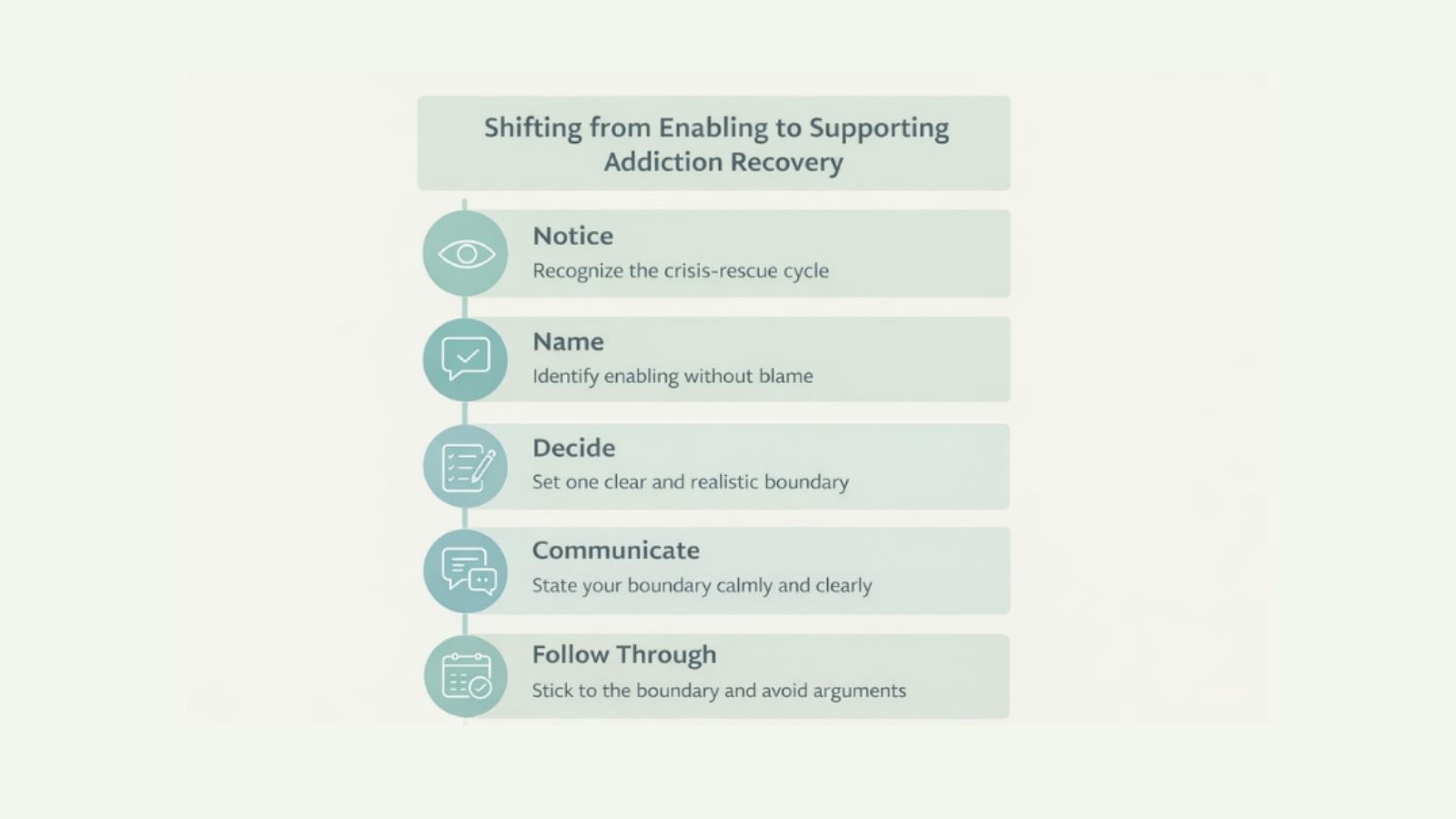
Step 1: Notice the cycle
Write down two recent situations. What happened before the crisis? What did you do? What happened after?
Step 2: Name it without blame
Try: “I’ve been rescuing you from consequences.”
Avoid: labels, insults, or arguments about character.
Step 3: Decide what changes now
Start with one boundary you can actually keep, often money or housing.
Examples:
- “I won’t give cash.”
- “I will pay treatment providers directly.”
- “I won’t call your employer.”
Step 4: Communicate a short, repeatable message
Script you can use:
“I love you. I’m not going to do things that make addiction easier. I will support recovery steps, including treatment.”
Step 5: Follow through consistently
You do not need to win an argument. You need to keep your boundary.
Handling Specific Scenarios: What to Do Instead

Scenario 1: When they ask for money
Enabling: Giving cash to stop the panic.
Supporting: Offering help tied to recovery.
Try:
“I can’t give cash. If you want help with treatment, I’ll sit with you while you call, and I can pay the provider directly.”
If your loved one is ready for structured help, explore addiction treatment programs in New Hampshire.
Scenario 2: When housing is at risk
Enabling: Paying back rent again and again.
Supporting: Offering recovery-centered options.
Try:
“I won’t pay rent again. I will help you explore treatment and recovery housing options.”
Scenario 3: When legal trouble happens
Enabling: Immediately removing every consequence.
Supporting: Allowing consequences while offering treatment pathways.
Try:
“I care about you. I’m not going to remove the consequences. I will support treatment and recovery planning.”
Scenario 4: When relapse happens
Relapse can be part of a recovery journey, but it calls for action.
Try:
“Thank you for telling me. Let’s contact your treatment team today. What support do you need that helps you get back on track?”
If outpatient care is the right level of structure, review Intensive Outpatient Program (IOP)
If mental health symptoms like depression, anxiety, or trauma are part of the picture, integrated care matters. Families can learn how dual diagnosis treatment for addiction and mental health supports healing by addressing both conditions together through coordinated, evidence-based care.
When Professional Support Helps Families Stop Enabling
Trying to change long-standing patterns alone is exhausting. Support for families can improve outcomes for everyone involved by providing structure, guidance, and accountability during difficult transitions.
Family counseling can help you:
- Set boundaries that are realistic and enforceable
- Communicate concerns without escalating conflict
- Reduce guilt-driven decisions rooted in fear
- Align family members so one person is not carrying the responsibility alone
You can learn more about how family therapy and counseling support helps families move from enabling to healthy, recovery-focused support.
FAQ: Enabling vs Supporting Addiction
Is setting boundaries the same as giving up?
No. Boundaries help you stay connected without making addiction easier. They protect the relationship over time.
What if my loved one gets angry when I stop enabling?
Anger is common when patterns change. Stay calm. Repeat the boundary once. Then step away from the argument and return to treatment options.
Can I help financially without enabling?
Yes. The safest approach is paying treatment providers directly or supporting recovery-related needs tied to a plan. Avoid cash and repeated crisis bailouts.
How do I know if I’m being too harsh?
Ask if you are protecting recovery or punishing. Supporting includes compassion, options, and clarity. It does not include rescuing from every consequence.
What if other family members keep enabling?
Focus on what you can control. Invite them into counseling, share a clear plan, and stay consistent. Mixed messages make recovery harder.

Help Without Hurting Recovery
Enabling vs. supporting addiction is one of the hardest shifts a parent or partner can make. It takes courage to stop rescuing, especially when fear is loud. But boundaries can protect your loved one’s chance to heal, and protect your own wellbeing too.
If you or someone you love is ready to take the next step, Heartfelt’s New Hampshire team is here to help. You can verify insurance and explore care options with a personalized plan that supports recovery.