Searching for addiction treatment from Lowell, Lawrence, or Chelmsford turns up a mix of Massachusetts facilities and New Hampshire ones just over the border. That’s not a coincidence or a targeting error. Southern New Hampshire and Northern Massachusetts function as one real treatment market, and providers on both sides of the line know it.
Heartfelt Recovery Centers, located in Hudson, NH, is one of the New Hampshire options that comes up. Before deciding whether crossing the border makes sense for your situation, it’s worth understanding exactly what that means: the drive, the insurance question, and what you’d actually be getting that’s different from staying local.
Why NH Options Show Up in Massachusetts Searches
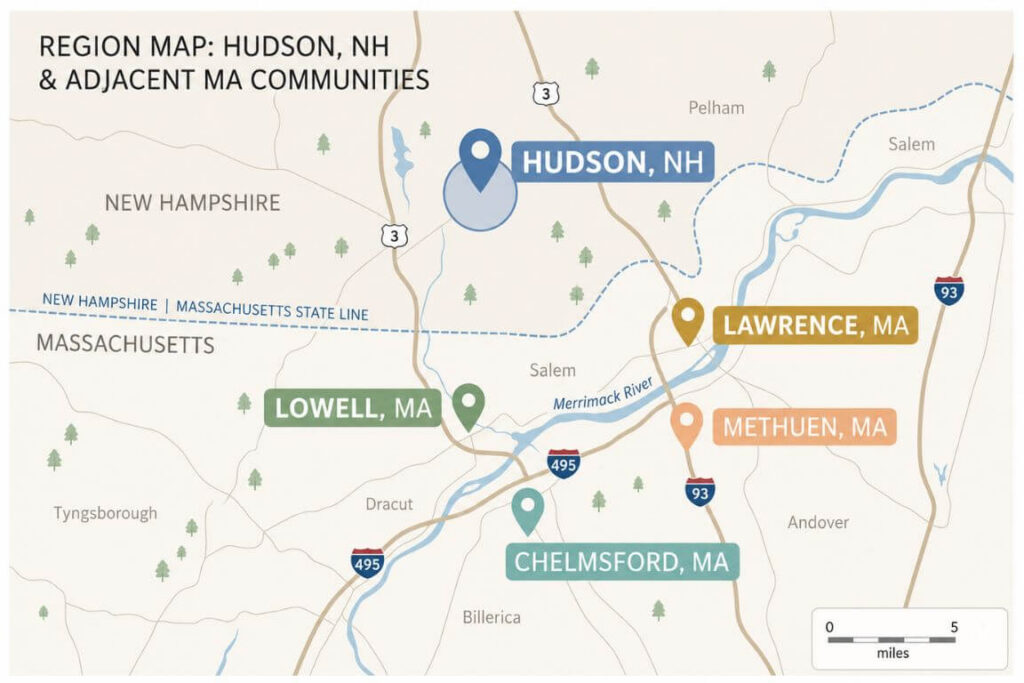
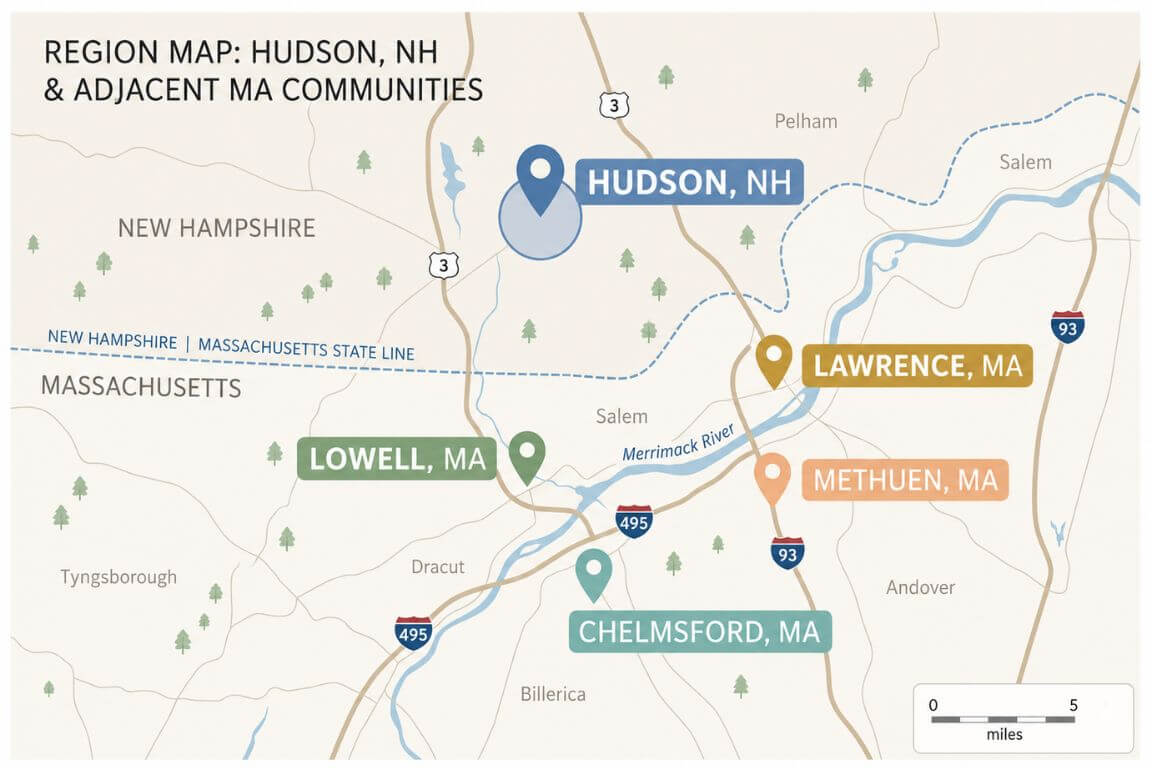
Hudson, NH, sits close enough to the Massachusetts border that Heartfelt Recovery Centers has built its patient base partly in Northern Massachusetts. The facility accepts patients from Lowell, Chelmsford, Lawrence, and Methuen under its Massachusetts provider credentialing, alongside the Southern New Hampshire communities that make up the majority of its patient population. Heartfelt’s dedicated page for patients in and around Lowell, MA covers service area details specific to that community. Full details on the facility itself and its accreditation are on Heartfelt’s treatment center location page.
The distance itself isn’t the obstacle it might sound like. Heartfelt is located within roughly a 30-minute drive of the New Hampshire towns closest to the state line, and the facility describes itself as accessible across the Massachusetts border into Lawrence and Lowell specifically. This model, an outpatient-only facility rather than a residential one, also tends to keep costs lower and preserves access to a wider range of insurance plans than a residential program would, since outpatient levels of care are generally reimbursed more consistently across carriers.
This isn’t only a question of proximity. Whether the person considering treatment is a spouse or parent researching options on someone else’s behalf, or an employed adult trying to get help without disrupting a job, the same logic applies: a program close enough to reach without an overnight stay, and flexible enough to work around a real schedule, matters more than which side of a state line it happens to sit on.
What You’d Actually Be Choosing
Crossing state lines for treatment only makes sense if it gets you something meaningfully different from what’s available closer to home. Here’s the honest comparison.
Heartfelt Recovery Centers is Joint Commission accredited and LegitScript certified, holds a 4.8-star rating across verified patient reviews, and offers a full continuum of outpatient care: Partial Hospitalization Program (PHP), Intensive Outpatient Program (IOP), standard outpatient, and Medication-Assisted Treatment (MAT) including Suboxone. Evening IOP scheduling is built specifically around commuting professionals and parents managing family responsibilities, which matters whether you’re driving from Nashua or from Lowell.
The distinction between PHP and IOP is worth understanding before that first call, since it shapes what the weekly commitment actually looks like. PHP runs closer to a full day, several days a week, and suits someone who needs more clinical structure and monitoring during the day. IOP is lighter, typically a few evening sessions a week, and is built for people who need to keep working or attending school while they get care. Neither one requires an overnight stay, and patients can step between levels of care as their needs change rather than starting over at a different facility.

Joint Commission accreditation specifically is worth understanding rather than treating as a logo on a website. It means the facility has been independently evaluated against national standards for patient safety, clinical quality, and ethical practice, the kind of verification that’s worth checking for at any facility you’re considering in Massachusetts or New Hampshire.
None of that makes Heartfelt automatically the right choice over a Massachusetts-based program. Plenty of Lowell, Lawrence, and Chelmsford providers offer comparable levels of care, and staying local means shorter drives and easier family involvement in sessions that require in-person attendance. The honest answer is that the right choice depends on what matters most to your specific situation: accreditation and program fit, distance, insurance network, or some combination.
The Insurance Question You Need to Ask First
This is the part that gets glossed over in a lot of “come to New Hampshire for treatment” content, and it shouldn’t be.
Heartfelt Recovery Centers accepts Medicaid NH, specifically the state’s managed care plans (AmeriHealth Caritas NH, NH Healthy Families, and WellSense), along with private insurance carriers including Anthem Blue Cross Blue Shield, Cigna, UnitedHealthcare, Aetna, Humana, and Medicare. It does not appear to accept MassHealth, which is Massachusetts’ own Medicaid program.
That distinction matters because MassHealth is structured around care received within Massachusetts. MassHealth is a healthcare program for Massachusetts residents who get their medical care in Massachusetts, and out-of-state coverage is generally limited to emergency situations rather than routine outpatient treatment. In practical terms, if you’re relying on MassHealth to cover treatment, a New Hampshire facility is unlikely to be a workable option, regardless of how close it is geographically. Massachusetts has its own extensive MassHealth-covered treatment network through the Massachusetts Behavioral Health Partnership, which coordinates behavioral health care for MassHealth members across a large network of in-state providers, and that’s where a MassHealth-dependent search should probably start rather than expanding across the border.
This isn’t a minor technicality. Insurance coverage is usually the single biggest factor in whether treatment actually happens, more than accreditation, reviews, or program philosophy. A facility that looks like the perfect fit on paper doesn’t matter much if the bill isn’t covered, so this question deserves to come before, not after, you’ve mentally committed to a specific place. You can check what’s generally covered under most plans before going further.
If you have private, commercial insurance instead, such as a plan through an employer, the picture is different. Private carriers like Aetna, Cigna, Blue Cross Blue Shield, and UnitedHealthcare generally operate across state lines, though your specific plan’s network and out-of-network benefits still need to be checked before assuming coverage. This is exactly the kind of thing worth confirming with a quick call rather than guessing. Verifying insurance directly before committing to a facility on either side of the border, avoid an unpleasant surprise partway through intake.

What Telehealth Does and Doesn’t Solve
Telehealth comes up a lot in the context of crossing state lines, since it seems like an obvious way to sidestep the commute entirely. It’s worth being precise about what’s actually available here.
Heartfelt’s telehealth programming is specifically described as available to adults anywhere in New Hampshire. That availability doesn’t extend to Massachusetts residents, since telehealth practice across state lines generally requires the provider to hold licensure in the patient’s state, not just their own. For Lowell, Lawrence, and Chelmsford residents, the confirmed pathway right now is in-person attendance in Hudson. If your situation makes a long-term commute genuinely difficult, that’s worth raising directly with admissions rather than assuming telehealth will be an option.
What a Typical Path Looks Like
For a Massachusetts resident who decides the drive and the fit are worth it, the process generally starts the same way it would for a New Hampshire resident: a confidential intake call covering substance use history, current symptoms, and insurance information, followed by a recommendation for the appropriate level of care.
Our guide comparing PHP and IOP in more detail walks through how that level-of-care decision actually gets made, since it’s rarely just about how severe the situation is on paper. Someone stepping down from a higher level of care elsewhere, or entering treatment for the first time with a stable home environment, might land in different places on that continuum even with similar substance use histories.
Once a level of care is set, the practical logistics matter more than people expect. IOP typically runs several evenings a week, so a Lowell resident is realistically looking at a recurring drive of well under an hour each way, comparable to a commute many people already make for work. It’s a real time commitment stacked on top of an already full week, which is exactly why evening scheduling, not just proximity, is often the more important factor in whether treatment actually fits into someone’s life.
Weekend availability matters for similar reasons. A working parent in Chelmsford or Lawrence juggling childcare and a job doesn’t have the same flexibility as someone with a more open schedule, and a program that only offers weekday daytime sessions effectively excludes a lot of people who need care just as much as anyone else. Ask directly about evening and weekend options at any facility you’re considering, on either side of the border, before assuming your schedule will accommodate whatever hours a program happens to offer.
For Families Watching From the Outside
If you’re the one researching this on behalf of a spouse, adult child, or sibling rather than for yourself, the state line question is often secondary to a bigger one: How do you get someone who isn’t fully on board to consider treatment at all? That’s a harder problem than geography, and it deserves more depth than a quick tip at the end of an insurance explainer. Our guide on how a professional interventionist supports families through that exact moment covers what that process actually looks like, including how to prepare for a conversation that goes nowhere on the first attempt.
Whether the person you’re trying to help ends up in Massachusetts or New Hampshire matters less than whether they end up somewhere at all. Keep that in mind if the logistics discussion starts to feel like the hard part. Often it isn’t.
Frequently Asked Questions
Does Heartfelt Recovery Centers accept patients from Massachusetts?
Yes. Heartfelt accepts patients from Lowell, Chelmsford, Lawrence, and Methuen under its Massachusetts provider credentialing, in addition to the Southern New Hampshire communities that make up most of its patient population.
Does MassHealth cover treatment at a New Hampshire facility?
Generally, no. MassHealth is structured for care received within Massachusetts, and out-of-state coverage is typically limited to emergencies. If MassHealth is your coverage, a Massachusetts-licensed provider is the more realistic option.
How far is Hudson, NH from Lowell or Lawrence?
Heartfelt describes itself as within roughly a 30-minute drive of the New Hampshire towns nearest the border and explicitly accessible from across the Massachusetts border into Lawrence and Lowell.
Is telehealth available to Massachusetts residents?
No, not currently. Heartfelt’s telehealth programming is available to adults anywhere in New Hampshire. In-person attendance in Hudson is the confirmed pathway for Massachusetts residents, so ask admissions directly if a long commute is a genuine barrier for you.
What if I have private insurance instead of MassHealth?
Private commercial plans, including Aetna, Cigna, Blue Cross Blue Shield, and UnitedHealthcare, generally work across state lines, though your specific plan’s network status should still be verified before committing to a facility.
Settle the Insurance Question Before You Decide
If you’re in Lowell, Lawrence, Chelmsford, or Methuen and weighing whether a New Hampshire facility makes sense for your situation, the insurance question is the one to settle first. Heartfelt Recovery Centers is Joint Commission accredited and happy to walk through what coverage and scheduling would actually look like for your specific plan. Verify your insurance or contact our admissions team directly, and get a straight answer before you plan around an assumption.
WRITTEN BY
Mitchell Cohen, LICSW, MLADC
Licensed Clinical Social Worker, Master Level Alcohol and Drug Counselor
Mitchell Cohen, LICSW, MLADC, is a licensed clinical social worker and Master Level Alcohol and Drug Counselor at Heartfelt Recovery Centers in Hudson, NH. With over 12 years of experience in outpatient addiction treatment, Mitchell specializes in family systems therapy, relapse prevention planning, and dual diagnosis treatment. He is trained in Cognitive Behavioral Therapy (CBT), Dialectical Behavior Therapy (DBT) and holds advanced certifications in family intervention techniques and trauma-informed care.

MD Mitchell Grant Cohen
Dr. Mitchell G. Cohen is a board-certified Internal Medicine specialist with over 34 years of experience in patient-centered healthcare. A graduate of Hahnemann University School of Medicine, Dr. Cohen completed his internship at the University Health Center of Pittsburgh, where he gained invaluable hands-on experience. He is also a certified addiction specialist, holding membership with the American Society of Addiction Medicine (ASAM).
Currently based in Nashua, NH, Dr. Cohen is affiliated with Saint Joseph Hospital, where he provides comprehensive care focusing on both internal medicine and addiction treatment. His expertise includes prevention, diagnosis, and management of adult diseases, as well as specialized care for individuals facing substance use disorders.
Dr. Cohen is committed to fostering open communication, ensuring his patients are fully informed and empowered to make confident decisions about their health and treatment options.