

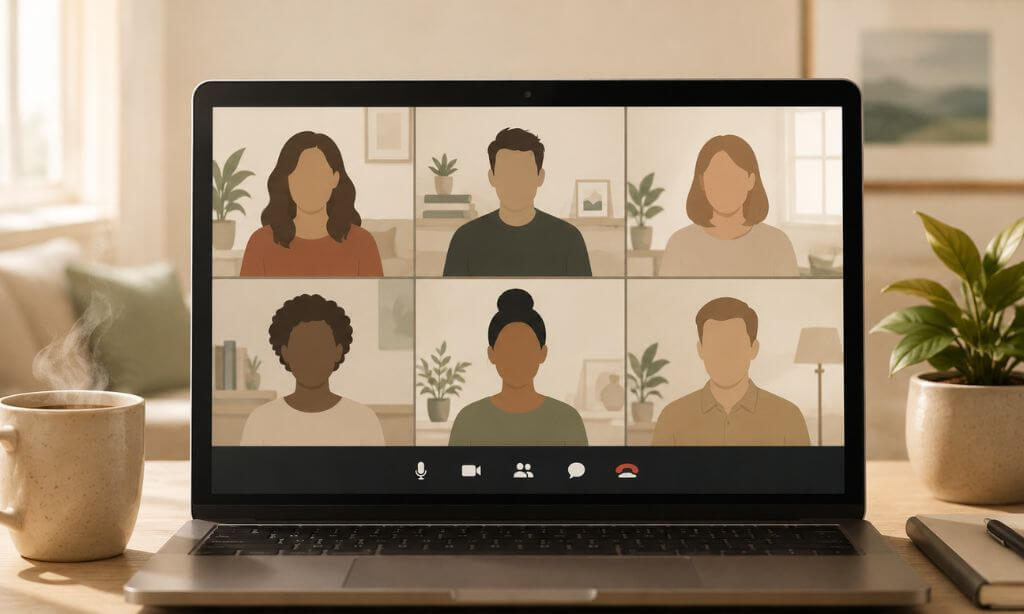
Telehealth addiction treatment lets patients attend therapy, group counseling, and medication management appointments from home instead of driving to a facility. For people juggling work, childcare, or a commute from Nashua, Manchester, or Northern Massachusetts, that difference is often what determines whether treatment happens at all.
Two questions usually come up before anyone commits to it. Does virtual treatment actually work, or is it a watered-down version of the real thing? And does it genuinely solve the scheduling and transportation problem, or just move it online? Both deserve a straight answer, and both matter more than a slick description of “flexible care” that doesn’t hold up to scrutiny.
At Heartfelt Recovery Centers, telehealth programming operates under the same Joint Commission-accredited standards as the in-person facility in Hudson, NH. That distinction matters because telehealth in behavioral health has grown fast enough that quality varies widely between providers, and accreditation is one of the more reliable signals that a program meets a consistent clinical standard regardless of format.
What Telehealth Addiction Treatment Actually Involves
Telehealth addiction treatment delivers the same clinical programming as in-person care, just through a secure video platform instead of a waiting room. At Heartfelt Recovery Centers, sessions are HIPAA-compliant and run by the same licensed clinicians using the same evidence-based therapies as the Joint Commission-accredited in-person programs at the Hudson, NH facility. No special equipment is required beyond a smartphone, tablet, or computer with a camera and a private place to sit for the session.
After intake, which can also happen over telehealth, patients receive a structured weekly schedule covering individual therapy, group therapy, and medication management. A clinical care coordinator stays involved throughout treatment to handle scheduling changes and troubleshoot the technical side, so the burden of making the technology work doesn’t fall entirely on the patient.
Does Virtual Treatment Work as Well as In-Person Care?
The honest answer is about the same, with a couple of caveats worth knowing.
A 2022 review in the peer-reviewed journal Psychiatric Services looked at eight published studies comparing addiction treatment delivered by telehealth against in-person treatment. Seven of the eight found telehealth to be as effective as in-person care, not more effective, across retention, therapeutic alliance, and substance use outcomes (Psychiatric Services, 2022). That’s a meaningfully different claim than “telehealth is better,” and it’s the more accurate one.
On the medication side, the HEALing Communities Study, a large-scale addiction treatment implementation study backed by the National Institute on Drug Abuse and SAMHSA, found that patients in Ohio who started buprenorphine treatment via telehealth stayed in treatment for 90 continuous days at a higher rate (32%) than those who started in a non-telehealth setting (28%), with no associated increase in overdose risk (NIDA, 2023). Retention matters because people who stay in treatment longer generally have better outcomes, regardless of format.
The caveat: some research has found slightly weaker group cohesion in virtual group therapy compared to in-person groups, with a minority of patients reporting they didn’t connect with other group members as well online. That’s not a reason to avoid telehealth. It’s a reason a good telehealth program pays attention to group size and facilitation quality, and it’s part of why clinical judgment, not just patient preference, should guide the decision between formats.
It’s also fair to note what the research doesn’t yet fully answer. Most of the strongest studies on telehealth for substance use treatment come from the period during and shortly after the COVID-19 pandemic, when telehealth adoption expanded rapidly out of necessity rather than as a carefully designed rollout. Longer-term data comparing years, not months, of telehealth versus in-person outcomes is still developing. None of that undermines the case for telehealth as a legitimate option today. It’s simply a reason to treat “comparable outcomes” as the accurate current summary, rather than overselling telehealth as definitively equal or superior in every respect.
What a Telehealth IOP Week Actually Looks Like
Here’s a representative week for someone in telehealth IOP. This is illustrative only: actual session counts, lengths, and days vary by clinical need, insurance authorization, and step-up or step-down status and should be confirmed with a treatment team rather than assumed from a general example. Our guide on how IOP supports addiction recovery goes deeper into how the level of care itself is structured.
| Day | Session Type | Typical Length |
| Monday | Group therapy (evening) | 2-3 hours |
| Tuesday | Individual therapy | 45-60 minutes |
| Wednesday | Group therapy (evening) | 2-3 hours |
| Thursday | Medication management (if applicable) | 20-30 minutes |
| Friday | Group therapy (evening) | 2-3 hours |
Evening group sessions are the backbone of IOP, whether virtual or in-person, because they let people keep working during the day. The difference with telehealth is simply where the person is sitting when the session starts.
Getting Suboxone or MAT Through Telehealth
Medication-assisted treatment, including buprenorphine-based medications like Suboxone, can be started and managed through telehealth for eligible patients, but the regulatory picture here is worth understanding rather than assuming it’s permanent.
The DEA and HHS have extended COVID-era telemedicine flexibilities several times since 2020. Under the current extension, DEA-registered practitioners can prescribe Schedule II-V controlled medications via telemedicine, including buprenorphine for opioid use disorder via audio-only encounters, without an initial in-person evaluation, through December 31, 2026 (DEA/HHS, 2025). Separately, a permanent rule expanding buprenorphine prescribing via telemedicine took effect at the end of 2025, giving providers a second, more durable pathway alongside the temporary extension. In practice, this means telehealth MAT prescribing is currently available and has been reliably extended year over year, though parts of the framework are still temporary rather than fully settled. Patients who begin MAT or Suboxone treatment through telehealth are also enrolled in structured IOP programming, since medication alone isn’t treatment. It’s one part of it. Our piece on staying sober while on medication-assisted treatment addresses a question that comes up often for patients starting MAT through telehealth.
When In-Person Care Still Makes Sense
Telehealth isn’t the right fit for everyone at every stage, and a program that pretends otherwise isn’t being straight with patients. In-person PHP or a higher level of structure tends to make more sense for people in early, acute withdrawal, those experiencing psychiatric instability, or anyone who finds it genuinely difficult to engage in a virtual format. A full intake assessment, not a patient’s format preference alone, should determine the starting point.
A hybrid path is common in practice: someone starts in-person while stabilizing, then steps down to telehealth IOP as things settle. Our guide comparing PHP and IOP in more detail walks through how clinicians decide when someone is ready to move between levels of care.
Dual Diagnosis and Family Support Through Telehealth
Substance use rarely shows up alone, and a telehealth program that only treats the addiction while ignoring what’s happening alongside it isn’t offering complete care. Dual diagnosis treatment is fully available via telehealth for patients managing co-occurring conditions such as depression, anxiety, PTSD, ADHD, or bipolar disorder alongside a substance use disorder. Treating both at once, rather than addressing one and hoping the other resolves on its own, tends to produce more durable results. If the terminology is confusing, our explainer on dual diagnosis versus co-occurring disorders breaks down the distinction.
Family therapy is also available through the same virtual platform, along with case management for coordinating insurance, scheduling, and other logistics. For a household where getting one person to weekly in-person family sessions was already a scheduling challenge, having that option available virtually removes one more reason treatment gets postponed. Our guide to family support resources in New Hampshire covers what’s available beyond the treatment program itself.
The Real NH and MA Commute Problem
For a lot of people in Southern New Hampshire and Northern Massachusetts, the barrier to treatment was never willpower. It was logistics. Hudson, Nashua, Manchester, Lowell, Lawrence, and Chelmsford sit close enough together that any one drive sounds manageable on its own, but IOP isn’t a single trip. It’s several sessions a week for months, layered on top of a full workday and family responsibilities, and that adds up fast regardless of the exact mileage involved.
Telehealth removes that math entirely for the sessions that don’t require a physical presence. It doesn’t replace medical monitoring or higher levels of structured care, but for the individual and group therapy sessions that make up the bulk of an IOP week, showing up no longer requires a car. For patients coming from Northern Massachusetts, Heartfelt’s Massachusetts-credentialed programming means that flexibility can be the difference between treatment fitting into a real week and treatment staying a someday plan.
This same flexibility issue comes up constantly for working professionals worried that treatment means choosing between their job and their recovery. Our page for professionals and employers covers that tension in more depth, and the flexibility telehealth adds is a direct answer to it.
What About Insurance?
Coverage for telehealth behavioral health care has actually gotten more stable over the past couple of years, though it’s worth being precise about what’s settled and what isn’t.
Medicare’s coverage of telehealth for behavioral health and substance use disorder treatment, specifically, has been established as a permanent benefit, including audio-only sessions and no geographic restrictions on where a patient can be located (CMS, Consolidated Appropriations Act of 2021). That’s a meaningfully different, and more secure, situation than Medicare’s general (non-behavioral) telehealth flexibilities, which have gone through several near-lapses and short-term extensions over the past year. Private insurance coverage for telehealth addiction treatment varies by plan and carrier, which is exactly why verifying insurance directly, rather than assuming coverage, is worth doing before starting treatment. Our breakdown of how insurance coverage works for addiction treatment in New Hampshire walks through the process in more detail.

Frequently Asked Questions
Is telehealth addiction treatment as effective as in-person treatment?
Research generally shows telehealth produces comparable outcomes to in-person treatment for retention, therapeutic alliance, and substance use, rather than better outcomes. It’s a legitimate format, not a lesser one, though some people connect less easily in virtual group settings.
Can I get Suboxone or other MAT medications through telehealth?
Often, yes, for eligible patients, under current DEA telemedicine prescribing flexibilities that are extended through the end of 2026. A clinical evaluation determines eligibility, and telehealth MAT is paired with structured IOP programming rather than offered as medication alone.
Do I need any special equipment for telehealth sessions?
No. A smartphone, tablet, or computer with a camera and a private space for the session is enough.
What if I need a higher level of care than telehealth can provide?
A full intake assessment will identify if in-person PHP or a more structured level of care is the better starting point, particularly for acute withdrawal or psychiatric instability. Many people start in-person and step down to telehealth as they stabilize.
Is telehealth addiction treatment available if I live in Massachusetts?
Telehealth providers generally need to be credentialed in the state where the patient is physically located during a session, and that requirement varies by state. Heartfelt Recovery Centers holds Massachusetts provider credentialing, which supports telehealth programming for patients located in the Massachusetts service area, in addition to New Hampshire.
Start Telehealth IOP From Home
If the drive to a facility, or the thought of sitting in a waiting room, has been the thing standing between you and treatment, that barrier may not be as fixed as it feels. Heartfelt Recovery Centers is Joint Commission accredited and LegitScript certified for both in-person and telehealth programming. Verify your insurance or contact our admissions team to talk through whether telehealth IOP fits your situation.
WRITTEN BY
Mitchell Cohen, LICSW, MLADC
Licensed Clinical Social Worker, Master Level Alcohol and Drug Counselor
Mitchell Cohen, LICSW, MLADC, is a licensed clinical social worker and Master Level Alcohol and Drug Counselor at Heartfelt Recovery Centers in Hudson, NH. With over 12 years of experience in outpatient addiction treatment, Mitchell specializes in family systems therapy, relapse prevention planning, and dual diagnosis treatment. He is trained in Cognitive Behavioral Therapy (CBT), Dialectical Behavior Therapy (DBT) and holds advanced certifications in family intervention techniques and trauma-informed care.

MD Mitchell Grant Cohen
Dr. Mitchell G. Cohen is a board-certified Internal Medicine specialist with over 34 years of experience in patient-centered healthcare. A graduate of Hahnemann University School of Medicine, Dr. Cohen completed his internship at the University Health Center of Pittsburgh, where he gained invaluable hands-on experience. He is also a certified addiction specialist, holding membership with the American Society of Addiction Medicine (ASAM).
Currently based in Nashua, NH, Dr. Cohen is affiliated with Saint Joseph Hospital, where he provides comprehensive care focusing on both internal medicine and addiction treatment. His expertise includes prevention, diagnosis, and management of adult diseases, as well as specialized care for individuals facing substance use disorders.
Dr. Cohen is committed to fostering open communication, ensuring his patients are fully informed and empowered to make confident decisions about their health and treatment options.